
PROJECTS WITHIN THE PROGRAMME
1. Program Seni Kreatif USM (1986-1987)
In this first project (July 86-Jan 1987), participants were primarily the children of university staff, and were aged between 10 and 12 years. This project was conducted at Panggong Sasaran (the black-box theatre of the USM Performing Arts School), as well as several outdoor locations in Penang. A document entitled Kursus Jangka Pendek Teater Kanak-kanak – Rangka Kerja, indicates a 24-week integrated arts curriculum consisting of visual arts, drama, improvisation, film screenings, and field visits.
Output: This first project ended with a showcase in January 1987. The document preparation for exhibition hints how one group of children welcomed the audience of parents and staff with a kolam, and that student’s notebooks and drawings were exhibited together with T-shirts screened with logos designed and printed by the students. A dance and mime drama depicting scenes from field trip observations of Penang Road was performed for the showcase. For the finale, students explained the construction of puppets they had made, and performed a short puppet piece.
Supporting Archival Materials for ‘Program Seni Kreatif USM’
Kursus Jangka Pendek Teater Kanak-kanak 1985, pg 1
Preparation for Exhibition Program (1987)
2. Project Wayang Kulit (1988-1989)
The focus of this second project (July 1988-April 1989), was traditional shadow puppetry as indicated by the curriculum framework title Project Wayang Kulit. This project was conducted mainly at the university museum which held a collection of puppets, musical instruments, and a model puppet stage. Classes consisted of lectures and films on wayang kulit and the study of puppets. An additional member of staff, Mohammad Jufri, a traditional puppeteer, helped train participants to play the musical instruments of the wayang kulit ensemble. This project introduced the concept of ‘total theatre,’ where participants studied various aspects of traditional puppet theatre such as visuals, music, movement, and drama to understand how it all comes together.
Output: There is no evidence of any showcase or exhibition.
Supporting Archival Materials for ‘Program Wayang Kulit’
3. Zam Zam and the Money Lender (1990-1991)
The third project (July 1990-January 1991) under Program Seni Kreatif USM, incorporated visual and dramatic arts together in a children’s performance. 2 instructors from the fields of visual and dramatic arts used the text of a short story as shared inspiration, to create a theatrical performance. Sugu Kingham’s visual arts classes were organised as an ‘open workshop’ entitled Program Seni Lukis (see Laporan Tahunan) which worked to provide artistic design for sets, costumes, etc. Janet Pillai meanwhile, worked on a Creative Drama Programme to transform the short story into a monologue drama (sometimes involving the visual arts participants as supporting actors).
Output: The final output from this programme was the combined effort of the two classes. A single participant from the drama class of the programme performed a monologue drama entitled ‘Zam Zam and the Moneylender,’ while the visual arts group came up with a comprehensive artistic design for the production, which included the poster, programme, and set design which they then executed. The performance and design exhibition toured schools and public spaces in Penang and Kuala Lumpur.
Supporting Archival Materials for ‘Zam Zam and the Money Lender’
Laporan Tahunan Program Seni Lukis Kanak Kanak USM (1990)
4. Illustrated Folktales (1991)
In 1991, as part of the Program Seni Lukis, Sugu Kingham organised a project on illustration for folktales and stories. He guided students to produce a series of collages which illustrated two stories; a folktale entitled, ‘Why the crow is Black,’ and a contemporary short story, ‘Tiga Ekor Gajah.’
Children had to first decide on the main scenes, then plot out a series of 4-5 illustrated scenes/episodes which would be able to convey the full story to the viewer. Collage was used as the illustration technique; torn bits paper were pasted to create a picture. Only 2 materials were allowed; glue and white and black paper (with occasional coloured pieces). The children were challenged; i) physically: to use their fine motor skills when tearing and shaping paper, ii) conceptually: to explore positive and negative space using only 2 flat colours to create shape, texture, and landscapes, and iii) to compose dramatic visuals for each episode to sequentially reveal plot.
Output: Participants performed a story-telling session and exhibited their illustrations. The story-telling was conducted using the collage work as a visual aid to the narration and also using puppets against a backdrop of hand painted slides. The students also provided a bit of a soundscape for effect. The audience consisted of university staff and parents.
Supporting Archival Materials for ‘Illustrated Folktales’
Slideshow of ‘IllustratedFolktales’
5. Integrated Arts Program (1992)
Between February and May 1992, a project entitled Program Seni Paduan (Integrated Arts Program) was initiated by Janet and Sugu, and aided by undergraduate student Pritam Singh from the School of Arts. 14 participants (aged 13-14 years) were recruited from a neighbouring school (SMK Jelutong), to receive integrated arts classes in drama, movement, visual arts, and music. Most of the classes seemed to have been conducted at the school, although there is photographic evidence which shows that some classes were conducted in Panggong Sasaran USM.
The project consisted of a series of classes lasting 10 weeks, which focused on exploring elements of art such as line space, shape, colour, etc. within visual arts, dance, music, and story-telling. These simple cross-disciplinary activities (see Integrated Arts Program for Young People – Elements of Design Pg 3 [1st week]) enabled children to explore some of the elements as they occur in images, sound, and movement.
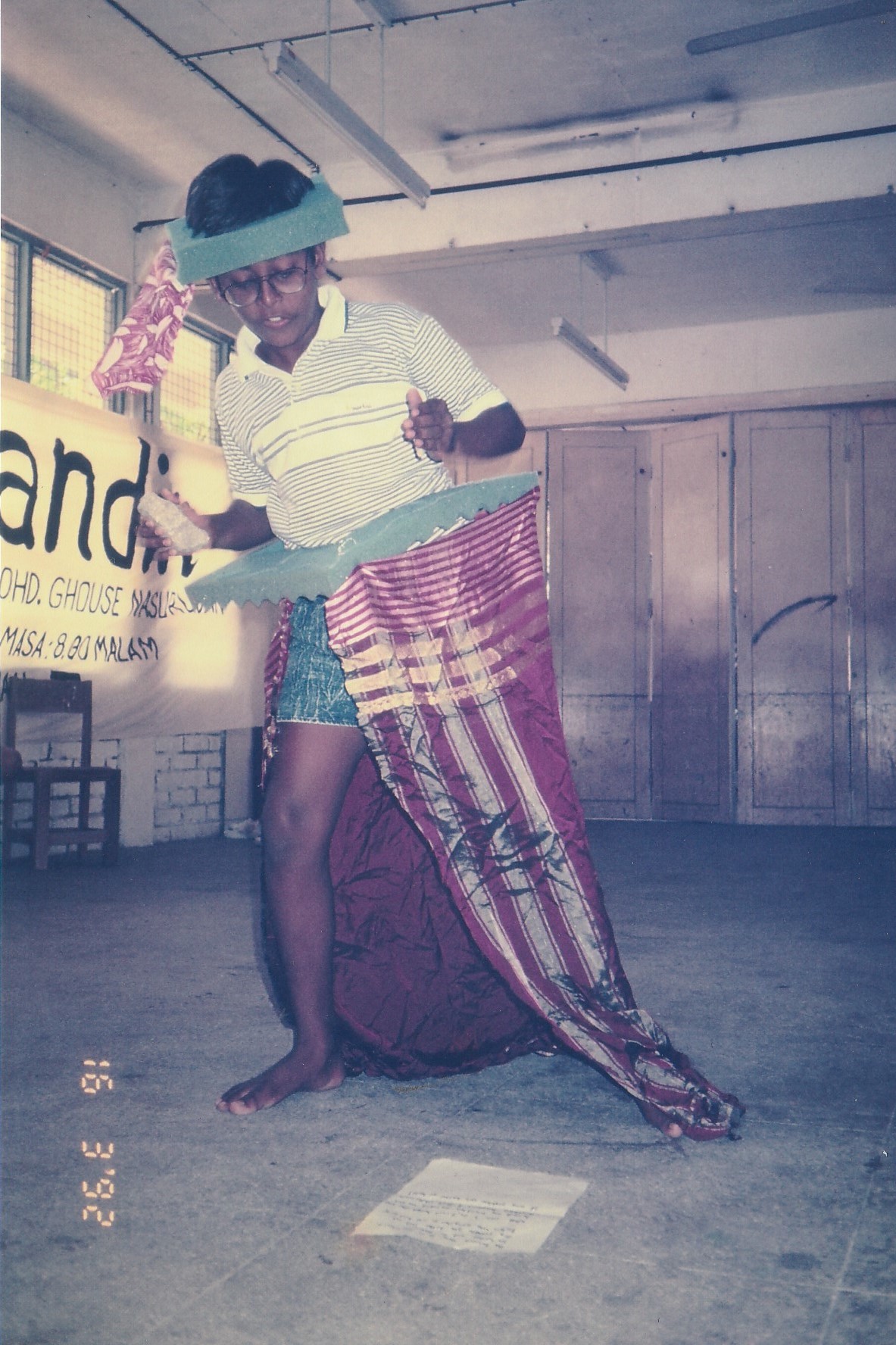
Images of children working with found materials in the integrated arts programme Source: Seni Kreatif USM
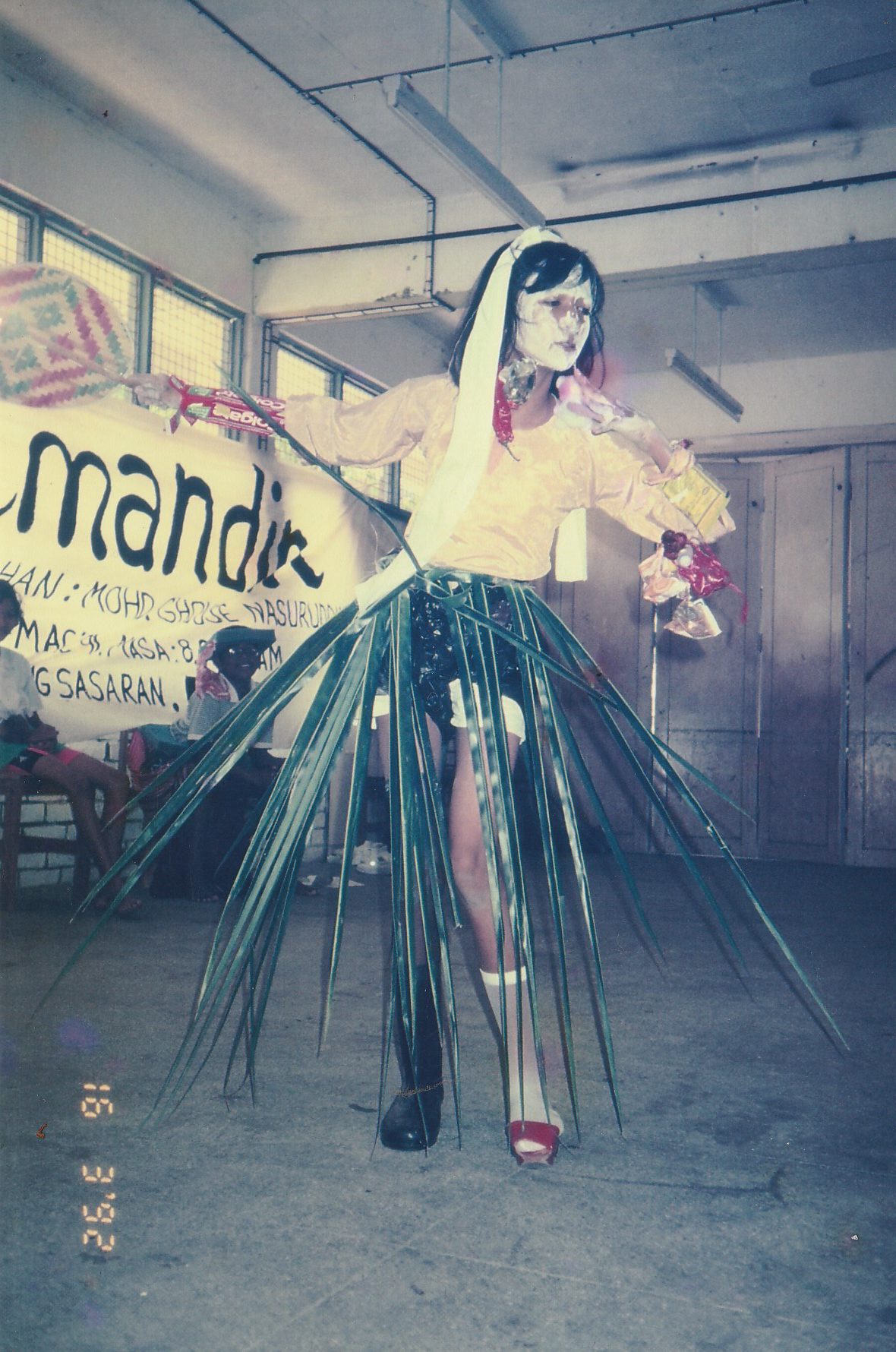
Images of children working with found materials in the integrated arts programme Source: Seni Kreatif USM
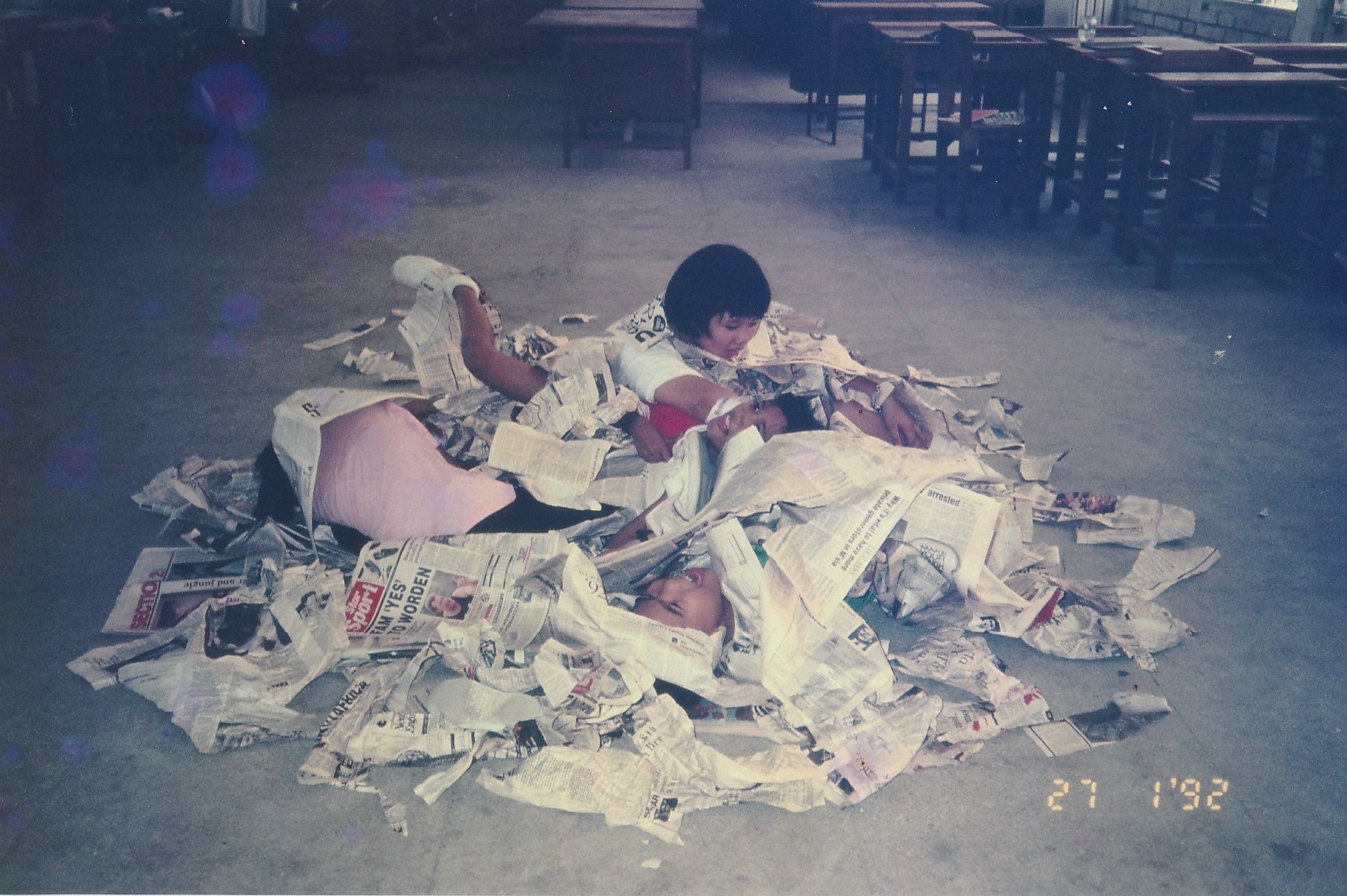
Images of children working with found materials in the integrated arts programme Source: Seni Kreatif USM

Visual Arts Intructor Sugu Kingham Source: Seni Kreatif USM